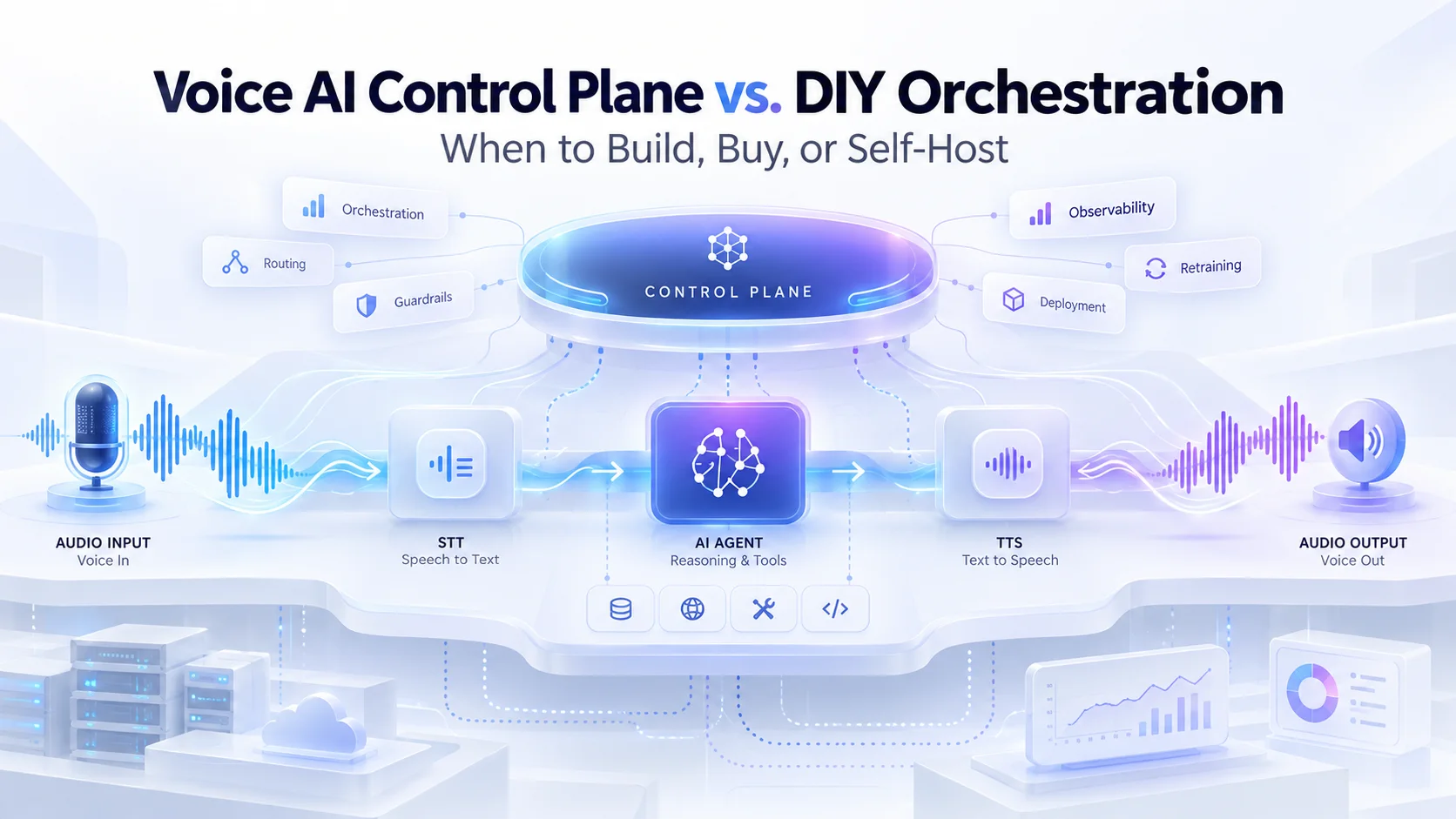
Should you build your own voice AI orchestrator, run an open-source runtime such as LiveKit Agents or Pipecat, or buy a managed platform? Buy managed to launch, build only the parts that differentiate you, and add a voice AI control plane once you run several agents, models or providers in production.
A voice AI control plane is the operational layer above the agent runtime. The runtime executes the conversation; the control plane handles model hosting, deployment, observability, provider fallbacks, evaluation and retraining. It does not replace LiveKit, Pipecat or a custom orchestrator: it sits above or alongside them.
Three things decide the answer for most teams:
- Voice is not a prompt chain. Turn-taking, barge-in, streaming state and telemetry are real-time systems problems that LLM frameworks such as LangChain do not solve on their own.
- Self-hosting has a break-even point. In the illustrative model below ($0.25/min managed, $0.05/min self-hosted, $300,000 a year of engineering), DIY only wins above 125,000 minutes a month.
- Operations outlast the build. Audio traces, latency percentiles, fallback rates and release control decide whether an agent survives production, whichever runtime executes it.
Build, buy or hybrid: the short answer
There are three practical ways to deploy production voice AI agents.
Our recommendation: start with managed infrastructure when speed matters most. Consider DIY orchestration when you need unusual real-time behavior or infrastructure control. For growing production deployments, evaluate a control plane that can manage your speech models, agents, hosting, monitoring and optimization without forcing you into a single model provider or runtime.
The real decision is not whether to build or buy your agent. It is which parts of the voice AI stack are strategically important for your team to own.
Why voice AI orchestration is harder than LLM orchestration
A basic voice agent can be assembled in an afternoon from a speech-to-text API, an LLM and a text-to-speech provider. Developers who know LangChain, LlamaIndex or custom LLM workflows often assume a production voice agent is the same prompt chain with speech interfaces attached. It is not.
A text application handles discrete messages: a request comes in, steps run, an answer goes out. Voice AI runs on continuous, bidirectional media streams. While the agent speaks, it must keep listening for interruptions. While the user talks, the system must decide whether they have finished. Every stage works inside a latency budget measured in milliseconds, not seconds.
The real-time voice AI pipeline
A common cascaded voice agent architecture looks like this:
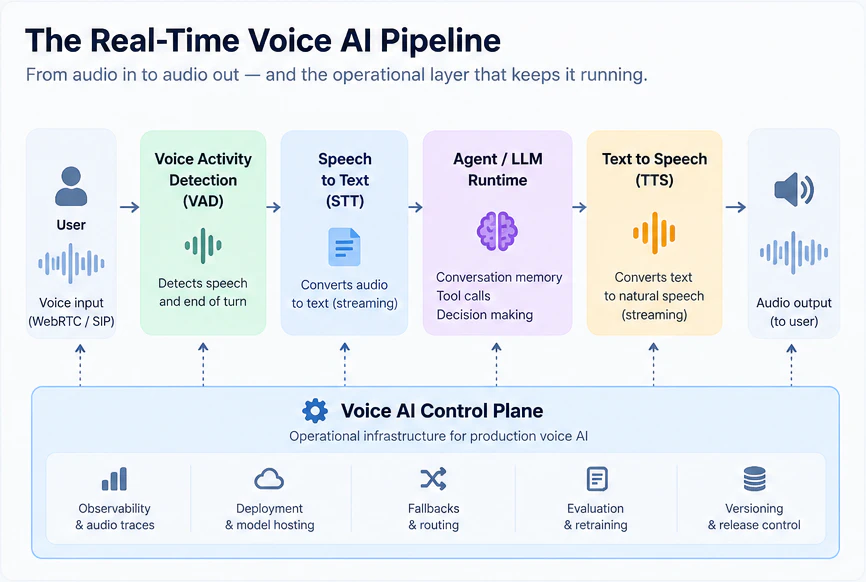
- Transport: caller audio arrives over WebRTC or SIP.
- Voice activity detection (VAD): detects speech and the end of a turn.
- Speech-to-text (STT): streams audio into text.
- Agent / LLM runtime: holds conversation memory, calls tools and decides what to say.
- Text-to-speech (TTS): streams the reply back as audio.
The control plane sits beneath all five: observability and audio traces, deployment and model hosting, fallbacks and routing, evaluation and retraining, versioning and release control.
Unlike a sequential request-response chain, this pipeline processes several concurrent streams and can cancel, redirect or restart work at any point. Four engineering problems matter most.
Turn-taking and voice activity detection
How does an agent know when someone has finished speaking? Basic VAD identifies speech and silence in an audio stream, but silence does not mean the thought is complete. Take a caller who says: "I'd like to book an appointment for Thursday... actually, make that Friday." An aggressive endpoint detector starts answering after "Thursday" and talks over the correction. A conservative one waits too long, and the conversation feels sluggish.
Production systems increasingly combine acoustic VAD with semantic turn detection, which uses linguistic context to tell a finished statement from a natural pause. The trade-off:
- Aggressive endpointing: faster responses, but more premature interruptions.
- Conservative endpointing: fewer premature responses, but higher perceived latency.
- Semantic endpointing: more context-aware decisions, with extra model and engineering complexity.
Turn-taking is not a prompt-engineering problem. It is an audio processing, inference and state-management problem.
Barge-in and interruption handling
Humans interrupt each other constantly, so a useful voice agent has to support barge-in: letting the user speak while the agent is still responding. Detecting the interruption is only the start. The orchestration layer then has to:
- Identify genuine user speech rather than acoustic echo or background noise.
- Stop or mute the audio currently playing.
- Cancel pending LLM generation and TTS synthesis.
- Flush buffered audio that should no longer be played.
- Update the agent's conversational memory to reflect what the user actually heard.
The last step is the easiest to miss. Suppose the agent generates a 20-second explanation and the customer interrupts after three seconds. If the LLM keeps the full generated response in its history, it will assume the customer heard information that was never delivered. Getting this right means synchronizing audio playback, the generation pipeline and conversation state.
WebRTC, WebSockets and telephony
Transport choice affects performance, and most production deployments use more than one protocol.
- WebRTC is the usual choice for interactive voice in browsers and mobile apps. It provides real-time media transport, jitter management and acoustic echo cancellation.
- WebSockets keep persistent bidirectional connections between backend services and streaming AI providers. TCP retransmissions and head-of-line blocking can add delay on poor networks.
- SIP and telephony integrations connect agents to the phone network, which adds codec conversion, narrowband audio, call routing and carrier reliability to the list.
One deployment may use WebRTC for browser conversations, WebSockets between inference services and SIP for phone calls, all in the same architecture.
Stateful streaming and cancellation
A traditional web application can usually retry a failed request. A voice application has to account for the timing and state of a live conversation. What happens if the TTS provider disconnects halfway through a sentence, the STT stream reconnects, or a tool call times out while the caller waits? The orchestration layer must decide whether to retry, fall back, apologize, transfer the call or continue with partial results. Those decisions are part of the customer experience.
Voice AI control plane vs. LangChain vs. LiveKit vs. Pipecat
Developers searching for a "voice AI orchestration framework" run into several technologies that solve different parts of the problem. They are not direct substitutes.
LangChain: application and LLM orchestration
LangChain orchestrates LLM-driven applications, tools, retrieval and agent workflows. It is useful inside a voice agent, for example to run retrieval-augmented generation, call business APIs or manage higher-level agent logic. On its own, it does not provide the real-time audio infrastructure for media transport, jitter, endpointing and interruption-aware playback.
Best fit: a component of the agent's reasoning layer, not a replacement for a real-time voice runtime.
LiveKit Agents: real-time media infrastructure
LiveKit Agents is a framework for building AI agents that join real-time audio and video sessions. It offers agent lifecycle management, integrations with STT, LLM and TTS providers, and flexible deployment. LiveKit Cloud adds managed deployment and agent observability. It suits browser-based agents, multimodal applications and telephony.
Best fit: teams that want programmable real-time media infrastructure and are comfortable building agents in code.
Pipecat: composable voice pipelines
Pipecat is an open-source framework built around passing audio, text and control frames through configurable pipelines. That gives developers granular control over how information flows between transports, STT models, LLMs, TTS engines and other components. You can run it on your own infrastructure or on the managed Pipecat Cloud.
Best fit: teams building highly customized voice agents that benefit from a frame-based architecture.
Voice AI control plane: lifecycle and infrastructure management
A voice AI control plane works at a different layer. Instead of focusing only on how an agent processes audio, it gives you one way to operate and improve voice AI systems across their lifecycle. Depending on the platform, that includes:
- Speech-to-text and text-to-speech model access
- Voice agent orchestration and configuration
- Model deployment and hosting
- Latency and performance monitoring
- Centralized traces, recordings and debugging
- Provider routing and fallback management
- Evaluation datasets and quality monitoring
- Model fine-tuning, retraining and version management
A control plane does not necessarily replace LiveKit, Pipecat or a custom agent runtime. A well-designed one sits above or alongside them, giving you a common operational layer while you keep control of the execution environment.
Architecture comparison
The key distinction is execution versus operations. Frameworks such as LiveKit and Pipecat help you build and execute agents. A control plane provides the infrastructure, visibility and workflows to run those agents in production. The categories overlap and every platform keeps expanding, so evaluate specific features rather than assuming each framework or control plane behaves the same.
Voice AI latency: what should you actually benchmark?
Latency is one of the most important characteristics of a conversational voice agent: an accurate model still produces a frustrating experience if its responses arrive late. For a cascaded architecture, a simplified response-latency budget is:
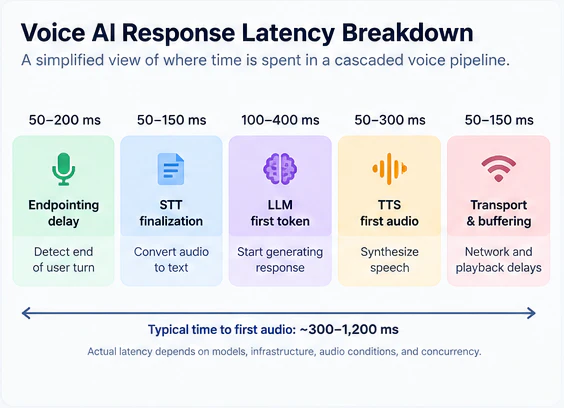
As a rough guide, endpointing takes 50–200 ms, STT finalization 50–150 ms, the LLM's first token 100–400 ms, TTS first audio 50–300 ms, and transport and buffering 50–150 ms: about 300–1,200 ms to first audio. Actual latency depends on models, infrastructure, audio conditions and concurrency.
The budget is not a strict sum in every implementation. Streaming stages overlap, and speculative processing can start before the user finishes speaking. What matters is the measured time between the end of the user's utterance and the first audible agent response.
Cascaded pipelines vs. native speech-to-speech
Native speech-to-speech models can reduce architectural complexity and preserve more acoustic information. Cascaded pipelines remain attractive when you need predictable tool execution, component-level observability, specialized speech recognition, or independently hosted and fine-tuned models. Neither architecture is universally faster or cheaper.
Measure P50, P95 and P99, not just the average
A system that feels responsive in a demo can behave very differently under concurrent load. Consider two hypothetical deployments:
Agent A looks faster at the median, but its worst-case performance is far less consistent. (These are hypothetical measurements, not results from a published benchmark.)
For production voice systems, monitor:
- End-of-turn-to-first-audio latency
- STT partial and final transcript latency
- LLM time to first token
- TTS time to first audio byte
- Tool execution latency
- Barge-in cancellation latency
- Transport jitter and packet loss
- P95 and P99 performance under concurrency
A useful voice AI benchmark measures the whole conversation pipeline, not one provider's model inference speed.
Build vs. buy: the real economics of self-hosting voice AI
Cost is one of the main reasons teams look at self-hosting. At high call volumes, removing a managed platform's markup creates meaningful savings. But comparing a platform's per-minute fee with raw model inference cost gives an incomplete picture: you also pay to develop, operate and maintain the system.
The hidden costs of DIY voice orchestration
A self-hosted deployment needs engineering effort across:
- Media server infrastructure
- Real-time streaming and state management
- Provider integrations and API upgrades
- Model serving and GPU capacity
- Autoscaling and concurrency management
- SIP connectivity and telephony
- Monitoring, alerting and incident response
- Recording storage and retention
- Evaluation, testing and quality assurance
- Failover, rollback and release management
Open-source frameworks provide some of these. The rest must be built, integrated or bought. Licensing may be free, but running the complete production system is not.
A 12-month voice AI cost comparison
The model below compares a managed platform with a self-hosted deployment under explicit, illustrative assumptions:
- Managed platform: $0.25 per call minute, including the underlying voice services.
- Self-hosted variable cost: $0.05 per call minute, covering provider usage and infrastructure.
- Engineering and infrastructure operations: an incremental $300,000 per year.
- Volume: constant from month to month, with no one-time migration cost.
These are simplified assumptions, not vendor quotes. For current vendor-by-vendor pricing, see our cost breakdown for scaling voice AI agents to 1,000+ concurrent calls.
The self-hosted column follows this formula:
Under these assumptions, the break-even point is:
Below that threshold, managed infrastructure is cheaper in this model. Above it, self-hosting becomes increasingly attractive. But 125,000 minutes is not a universal number: it moves substantially with vendor prices, provider choices, engineering capacity and the infrastructure your team already runs.
How a control plane changes the calculation
The comparison above assumes two extremes: fully managed or fully self-operated. A third option is to self-host the expensive or strategically important components and use a control plane for shared operational services. For example:
- Self-host your specialized speech recognition model.
- Use a managed TTS provider.
- Run custom agent logic on an open-source runtime.
- Centralize deployment, telemetry, evaluation and model lifecycle management.
This captures some of the benefits of self-hosting without building every operational tool internally. The economics depend on the control plane's fees, its infrastructure requirements and how much ongoing engineering work it removes.
The better question is not "How many minutes until we should self-host?" It is "Which components deliver enough differentiation or savings to justify owning them?"
Production observability: why a control plane matters
A conventional LLM application can often be debugged by reviewing the prompt, retrieved context, tool calls and final response. Voice AI needs deeper instrumentation.
Imagine a customer complains that an agent interrupted them, misunderstood the question and gave a wrong answer. Was the cause inaccurate speech recognition, premature endpointing, the LLM's response, a slow tool call or audio playback state? Without end-to-end visibility, these failures are hard to tell apart.
The four layers of voice AI observability
A production control plane should expose these signals on one correlated conversation timeline, and roll them up into fleet-level views of latency bottlenecks and provider fallback rates.
Why audio traces matter
Text transcripts alone cannot fully explain a voice interaction. Consider this one:
Customer: "I want to cancel my appointment."
Agent: "Your appointment has been canceled."
It looks successful. But the recording might reveal that the customer said "I don't want to cancel my appointment" and the STT engine missed the negation. Or the agent may have generated a correct response that never played because the caller interrupted.
Useful audio tracing distinguishes five things:
- Inbound audio: what the speech model received.
- Recognized transcript: what the STT engine interpreted.
- Agent output: what the model decided to say.
- Synthesized audio: what the TTS engine generated.
- Delivered audio: what the playback or media transport reported as delivered.
The last distinction matters: generated speech is not necessarily heard speech. Where possible, timestamps should correlate recordings, transcripts, inference spans, tool calls and interruption events. For teams running several agents or models, that visibility is most valuable when investigating systemic failures rather than individual calls.
Audio data also needs appropriate controls for recording consent, access permissions, retention, redaction and customer privacy.
From observability to retraining: closing the improvement loop
Diagnosing production failures is only half the problem. What happens after your team finds that an agent consistently mishandles one class of conversations? Traditional deployments rely on a fragmented workflow:
- Export failed call recordings and transcripts.
- Manually identify representative failures.
- Label or correct training examples.
- Fine-tune or retrain a model on separate infrastructure.
- Deploy the new version.
- Manually compare production behavior.
That process is slow and hard to scale. A more complete voice AI control plane connects monitoring directly to model improvement.
The continuous voice AI improvement loop
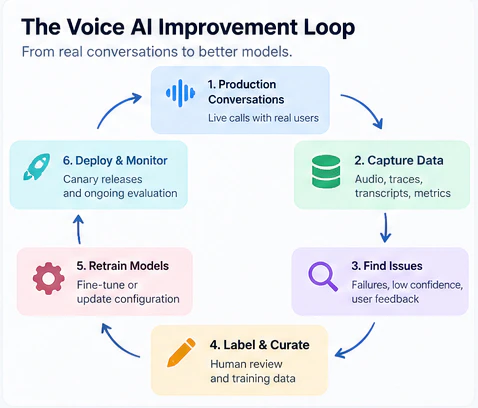
- Production conversations: live calls with real users.
- Capture data: audio, traces, transcripts and metrics.
- Find issues: failures, low-confidence results and user feedback.
- Label and curate: human review turns failures into training and evaluation data.
- Retrain models: fine-tune or update configuration, then evaluate offline.
- Deploy and monitor: canary releases and ongoing evaluation, then repeat.
This loop is most compelling when you have proprietary domain data. A customer support organization might accumulate thousands of recorded conversations full of specialized terminology, product names or industry jargon. Rather than continually adjusting prompts to compensate for recognition errors, it could use labeled examples to improve a domain-specific speech recognition model. Similarly, a company might fine-tune a smaller language model for narrow tasks such as intent classification, call disposition or routing.
Retraining is not always the right fix. Some failures are better addressed with prompt changes, retrieval improvements, tool fixes, endpointing adjustments or a different model provider. The control plane's job is to make these problems measurable so the team can pick the right intervention.
Why hosting and retraining belong together
Retraining creates a second operational problem: deployment. Once a model has been improved, the team still needs to:
- Version the model artifact and its configuration.
- Deploy it to an inference environment.
- Test latency and quality under production-like traffic.
- Compare performance against the existing version.
- Roll out the change gradually.
- Roll back if performance deteriorates.
A centralized hosting and deployment layer reduces the friction between improving a model and putting it into production, especially for organizations running several STT, TTS and specialized language models.
The strategic value is not simply being able to retrain a model. It is having an operational system that connects real-world failures to measurable improvements and safely returns those improvements to production.
How to host voice AI agents: three deployment patterns
No single deployment architecture fits every voice application.
Option 1: fully managed hosting
The voice AI provider manages the runtime, scaling and most supporting infrastructure. Choose this when:
- You are launching an MVP or initial production deployment.
- You don't have a dedicated real-time infrastructure team.
- Speed to market matters more than fine-grained infrastructure control.
- Your use case fits the provider's supported capabilities.
The main trade-offs are provider dependence, variable pricing and limits on low-level customization.
Option 2: self-hosted voice agent infrastructure
You deploy an open-source runtime or custom orchestrator into your own infrastructure. A typical architecture includes:
- LiveKit Agents or Pipecat
- Kubernetes or another container orchestration platform
- Self-hosted or API-based STT, LLM and TTS
- SIP integration for telephone calls
- Metrics collection, tracing and recording storage
- CI/CD, autoscaling and infrastructure monitoring
Choose this when:
- You need specialized pipeline behavior.
- You have enough engineering capacity.
- You require infrastructure-level customization or control.
- Your economics justify operating the system yourself.
Self-hosting also means planning for availability, GPU utilization, concurrency, incident management and security.
Option 3: hybrid hosting with a voice AI control plane
A hybrid model separates execution infrastructure from centralized operational management. The team hosts some agents or models itself and relies on control-plane services for:
- Unified model access
- Managed STT and TTS
- Agent configuration and deployment
- Model hosting
- Observability and debugging
- Evaluation and retraining workflows
- Versioning and release management
Choose this when:
- You want to keep control of model selection and custom agent behavior.
- You want flexibility between hosted and self-hosted components.
- Your organization runs multiple agents or model versions.
- You want one operational workflow instead of a collection of disconnected tools.
Before adopting this model, verify the platform's actual support for your runtimes, networks, deployment destinations, data residency requirements and model formats. A hybrid architecture is only useful if the operational benefits outweigh the integration complexity.
A decision framework: build, buy or self-host?
Before committing to an architecture, place your team against each factor.
Our recommendation by deployment stage
At the scale stage, a voice AI control plane becomes an important architectural layer, particularly when you operate many agents, providers or model versions.
Own your differentiation, not every infrastructure problem
There is no universal winner in the voice AI build-versus-buy debate. Managed platforms are often the fastest route to production. Open-source frameworks such as LiveKit and Pipecat give developers substantial control over agent behavior and deployment. Fully self-hosted architectures become economically compelling at high utilization.
But production voice AI needs more than a runtime. Teams have to understand what happened during conversations, identify reliability problems, compare model performance, manage deployments and keep improving the systems that handle their customers. That is the opportunity for a voice AI control plane.
The goal is not to eliminate developer control. It is to let engineering teams focus on building better voice AI applications instead of duplicating the infrastructure required to operate them.
Frequently asked questions
Should I build my own voice AI orchestrator or use a control plane?
Build your own orchestrator only if real-time behavior or infrastructure control is a core differentiator and you have dedicated real-time engineers. Otherwise, start on a managed platform or an open-source runtime such as LiveKit Agents or Pipecat, and add a control plane for hosting, observability, fallbacks and retraining once you run several agents or models in production. In an illustrative model with $300,000 a year of engineering overhead, self-hosting only becomes cheaper above about 125,000 call minutes a month.
What is a voice AI orchestration framework?
A voice AI orchestration framework is software that coordinates the components of a conversational voice agent: audio transport, speech recognition, language model inference, speech synthesis, tool execution, turn-taking and interruptions. Examples include LiveKit Agents and Pipecat.
What is the difference between a voice AI control plane and LangChain?
LangChain orchestrates LLM applications, tool calls and retrieval workflows. A voice AI control plane manages and operates voice AI infrastructure, which can include STT, TTS, agents, hosting, observability, evaluation and retraining. They are complementary rather than competing technologies.
Is LiveKit or Pipecat better for voice AI agents?
LiveKit is a strong choice for developers who want integrated real-time media infrastructure, including WebRTC-based experiences. Pipecat suits teams that want granular control over frame-based processing pipelines. Both can support production voice AI; the better choice depends on your transport, deployment and customization requirements.
Can I self-host voice AI agents?
Yes. You can self-host agents with frameworks such as LiveKit Agents or Pipecat, alongside self-hosted or external inference services. You also have to account for media transport, scaling, model deployment, monitoring and operational reliability.
Is self-hosting voice AI cheaper than using a managed platform?
It can be at scale, but the break-even point depends on provider prices, call volume, utilization, engineering overhead and infrastructure requirements. In an illustrative model with $0.25 per minute managed, $0.05 per minute self-hosted and $300,000 a year of engineering, the break-even is 125,000 minutes a month. Lower variable costs do not automatically mean lower total operating costs.
What is the difference between a voice AI control plane and a voice AI platform?
A voice AI platform usually focuses on building and deploying agents through a managed product or API. A voice AI control plane emphasizes centralized management across the operational lifecycle, which can span existing runtimes, multiple model providers, hosted inference, monitoring, evaluation and retraining. In practice, the categories overlap.
Can I fine-tune my own STT or LLM models for voice AI?
Yes, provided the model architecture, licensing, tooling and available training data support fine-tuning. Common use cases include domain-specific transcription, intent classification, specialized vocabulary and task-specific agent behavior. Evaluate model quality before deployment.
What are the most important voice AI performance metrics?
Key metrics include end-of-turn-to-first-audio latency, STT accuracy, LLM and TTS response times, P95 and P99 latency, interruption handling, conversation completion rates, fallback frequency and cost per successful conversation.
Assumptions behind these numbers
- Cost model: $0.25 per minute managed, $0.05 per minute self-hosted variable cost and $300,000 a year of incremental engineering and operations, at constant monthly volume with no migration cost. These are illustrative figures, not vendor quotes.
- Latency figures: the stage-by-stage ranges and the Agent A / Agent B percentiles are illustrative, not results from a published benchmark.
- Framework capabilities: LangChain, LiveKit and Pipecat change quickly. Check each project's current documentation before you commit to an architecture.
Sources and further reading

Turn Calls into Deals
with Bearworks
Ready to get started? Book a demo: