Evaluate the vendor, not just the AI agent. You are choosing a partner for transformation, not just a product. A great voice AI demo can be impressive: the agent sounds natural, answers questions intelligently and completes tasks in seconds. But a polished demonstration does not tell you how the system will perform after thousands of customer conversations, unexpected failures or months of continuous operation.
The real challenge is not getting a voice AI agent to work once. It is making it reliable, secure, cost-effective and continuously better in production. Whether you are evaluating AI voice agents for customer support, sales, appointment scheduling or enterprise automation, these five questions will help you separate impressive demos from platforms built for long-term success:
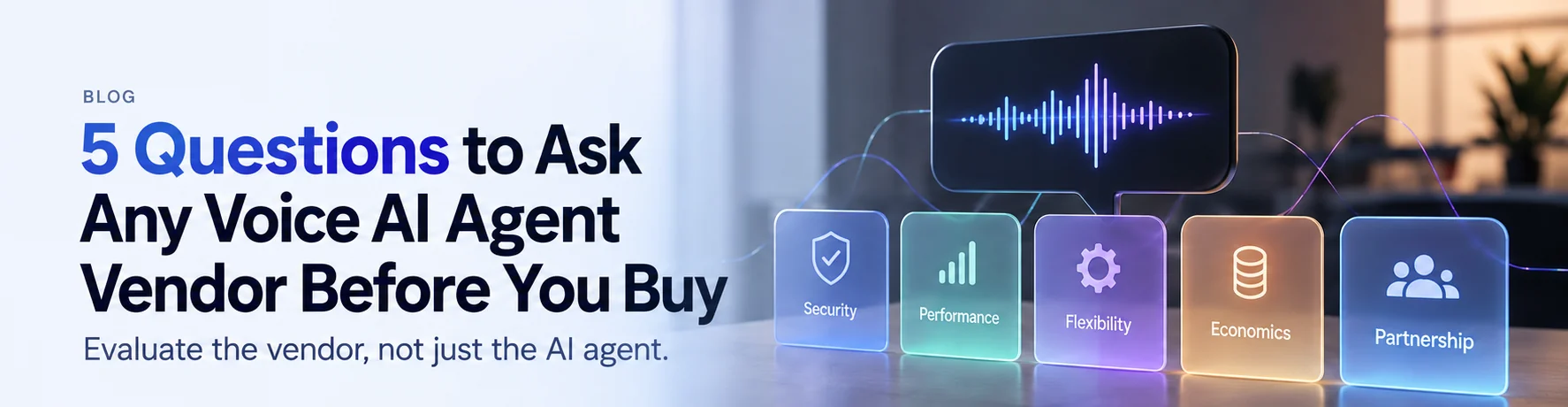
- Security and compliance: Is your voice AI platform secure, compliant and trustworthy?
- Reliability and improvement: How do you make sure agents perform reliably and improve over time?
- Architecture and flexibility: How flexible is your technology, and will it integrate with our existing systems?
- Economics and scalability: What is the true total cost of ownership, and how does it change at scale?
- Partnership and support: What kind of long-term partner will you be as our needs evolve?
The order is deliberate. It moves from trust, to operations, to technology, to economics, to partnership. For each question below you will find what to ask, what a good answer looks like and the red flag to watch for.
1. Is your voice AI platform secure, compliant and trustworthy?
Voice AI agents routinely handle sensitive customer information, from contact details and account records to payment information and private conversations. Understanding how vendors protect this data is essential.
Security is not simply about encryption. It is also about where data travels, who can access it, how long it is retained and what the AI agent is authorized to do.
What to ask your vendor:
- Data privacy: Where are call recordings, transcripts and customer data processed and stored? What are your retention and deletion policies?
- Model training: Are our conversations used to train your models or third-party AI models? Can we control how our data is used?
- Compliance: Do you support SOC 2, HIPAA (including a signed business associate agreement), GDPR or other industry-specific requirements? Can you provide supporting documentation?
- Access controls: How do you prevent agents from disclosing sensitive information or executing unauthorized actions?
2. How do you ensure your AI agents perform reliably, and improve over time?
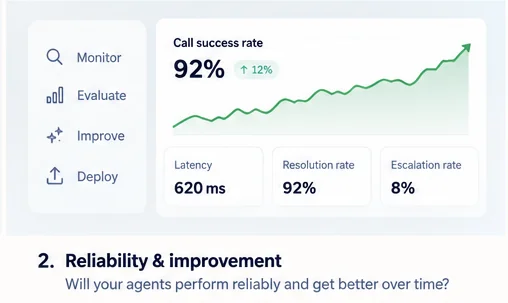
Getting an AI agent into production is only the beginning. As customer behavior evolves, prompts change, knowledge becomes outdated and underlying models are upgraded, agent performance can deteriorate. A voice AI vendor should help you detect problems before they affect large numbers of customers, and provide a clear path to fixing them.
What to ask your vendor:
- Performance monitoring: Can we track call success, resolution rates, latency, failed tool calls and escalation rates in real time?
- Quality assurance: How do you identify hallucinations, unsuccessful conversations, unexpected behavior and performance degradation?
- Testing and deployment: Can we test changes against historical conversations, roll out updates gradually and roll back problematic releases?
- Continuous improvement: Can we use our own recordings, transcripts and labeled conversations to improve agent performance through prompt optimization, evaluations or model fine-tuning?
3. How flexible is your technology, and will it integrate with our existing systems?
Voice AI is evolving rapidly. The speech recognition, language models and text-to-speech engines that perform best today may not be the best options six months from now. Your vendor's architecture determines whether you can take advantage of new technologies, or become locked into yesterday's models.
What to ask your vendor:
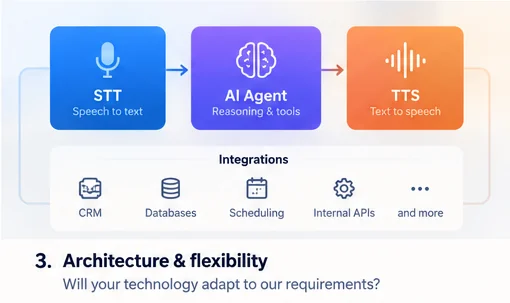
- Architecture: Do you use a speech-to-text, LLM and text-to-speech pipeline, native speech-to-speech models or a hybrid approach? What are the trade-offs?
- Performance: What are your real-world response latency metrics, including P95 and P99 latency? How does the agent handle interruptions and overlapping speech?
- Integrations: Can your agents reliably connect with our CRM, databases, scheduling tools and internal APIs? How are failures, retries and authorization managed?
- Flexibility: Can we swap AI models, use custom-trained models or self-host components without rebuilding the agent?
- Portability: If we leave your platform, can we export our data, prompts, configurations and training assets?
For example, a modular voice AI architecture can let an organization upgrade speech recognition or speech synthesis independently, rather than replacing the entire application. Native speech-to-speech systems, on the other hand, may offer advantages in processing conversational cues and reducing some audio processing overhead. The right choice depends on your performance, customization and compliance requirements. Write-ups from Deepgram and Cerebrium make the same trade-offs concrete: cascaded pipelines are easier to swap and inspect, speech-to-speech is harder to debug and can get more expensive on longer sessions, and Cerebrium finds that most cascaded latency comes from the network between stages rather than the models themselves, so where the components are hosted matters. For a deeper look at the trade-offs, see our guides to optimizing the full STT-LLM-TTS pipeline and to build vs. buy for voice AI infrastructure.
4. What is the true total cost of ownership, and how does it change at scale?
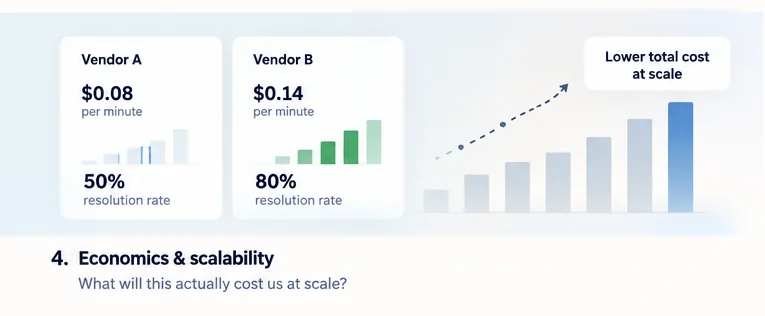
Voice AI vendors often advertise compelling per-minute pricing. But the cheapest rate does not necessarily translate into the lowest operating cost. A platform that charges less per minute but fails to resolve customer issues may ultimately cost more through repeated calls, failed interactions and human escalations.
What to ask your vendor:
- All-in pricing: Does your quoted rate include speech recognition, language model inference, text-to-speech, telephony, recording storage and platform fees?
- Usage billing: Are we charged for silence, failed calls, hold times, transfers and rounded-up minutes?
- Scaling economics: How do pricing, concurrency limits, minimum commitments and overage fees change as call volume increases?
- Business outcomes: What is the expected cost per successfully resolved call, including human escalation and operational overhead?
- Service guarantees: What uptime SLAs, incident response commitments and support guarantees are included?
Why the cheapest per-minute rate may not win
Consider two hypothetical AI voice vendors handling four-minute customer calls:
Although Vendor B costs more per minute, it sends 300 fewer calls per 1,000 to human agents. Once the cost of human support is included, Vendor B delivers the lower total cost of ownership. In this example it wins as long as a single human escalation costs more than $0.80. The metric that matters is not cost per minute. It is cost per successful resolution. Haven AI's AI call center pricing benchmarks make the same argument and show how a low headline rate can grow once platform, speech-to-text, LLM, text-to-speech and telephony layers are added. To pin down what you will actually be billed, ask for a dated quote that states billing increments, plus sample invoices, as suggested in VaniAgent's voice-agent RFP template. For a model of what voice AI costs as volume grows, see how to scale voice AI agents to 1,000+ concurrent calls without breaking the bank.
5. What kind of long-term partner will you be as our needs evolve?
Deploying a voice AI agent is not a one-time software purchase. It is an ongoing operational commitment. Your business will change, customer expectations will evolve, new models will emerge and your integration requirements will expand. A good vendor should help you navigate that evolution rather than leaving you to manage the complexity alone.
What to ask your vendor:
- Implementation: How long does deployment typically take, and what engineering or operational resources will our team need?
- Support: Who helps us troubleshoot production issues, improve conversation flows and integrate new systems?
- Failure handling: What happens when an agent cannot resolve an issue? Can it transfer calls to humans with the full conversational context?
- Roadmap: How do you incorporate new AI models, support emerging capabilities and help customers adopt improvements?
- Ownership and exit: Who owns our conversation data, training datasets and custom models? Can we migrate away without excessive cost or disruption? Ask for the ownership documents and the export and cutover procedure in writing before you sign (the VaniAgent RFP template is a useful checklist).
Voice AI vendor evaluation checklist: the five questions at a glance
Use this condensed scorecard when comparing providers.
An effective vendor evaluation should include a hands-on proof of concept using your organization's actual business scenarios, not just a vendor-controlled demonstration. Request relevant performance metrics, security evidence, pricing breakdowns and a concrete implementation plan before making a final decision. If your procurement team wants a longer, RFP-style list, Worqlo and Institute PM publish detailed AI vendor RFP question sets.
Beyond the AI agent: why the control plane matters
Most voice AI evaluations begin with the agent itself. How natural does it sound? Does it respond quickly? Can it follow instructions and execute tasks? Those are important questions, but they only describe what the customer experiences. Behind every production voice agent is a much larger infrastructure stack:
As organizations scale from a single agent to dozens of production workflows, managing these components becomes increasingly complex. A voice AI control plane provides a centralized way to manage the underlying models, infrastructure, deployments and lifecycle of voice AI systems. Instead of treating each agent as an isolated application, businesses can build a repeatable process for deploying, monitoring, evaluating and improving AI agents over time.
This is particularly valuable for organizations that want to keep control over their technology choices, use proprietary training data or avoid becoming dependent on a single AI provider.
How Bearworks helps organizations take control of voice AI
At Bearworks, we are building a voice AI platform designed to give organizations greater control over the technology powering their agents. Our platform brings together core voice AI capabilities, including speech-to-text, text-to-speech, AI agents, model retraining and model hosting, so teams can build and improve voice AI systems as their needs evolve.
We believe the future of enterprise voice AI is not simply about deploying more agents. It is about creating systems that are reliable, adaptable and continuously improving. Before you commit to a platform, make sure you are choosing a partner that can support not only where your AI strategy is today, but where you want it to go next.
Frequently asked questions
What questions should I ask a voice AI agent vendor?
Ask five questions: (1) Is the platform secure, compliant and trustworthy? (2) How do you make sure agents perform reliably and improve over time? (3) How flexible is the technology, and will it integrate with our existing systems? (4) What is the true total cost of ownership, and how does it change at scale? (5) What kind of long-term partner will you be as our needs evolve? Together they cover security, reliability, architecture, economics and partnership.
How do I evaluate a voice AI vendor beyond the demo?
Run a hands-on proof of concept using your organization's actual business scenarios rather than a vendor-controlled demonstration. Before you decide, request performance metrics, security evidence, a pricing breakdown and a concrete implementation plan. A demo shows what the agent can do once; a proof of concept shows how the platform behaves over thousands of conversations, failures and changes.
What security and compliance questions matter most for voice AI?
Ask where call recordings, transcripts and customer data are processed and stored, how long they are retained and how they are deleted. Ask whether your conversations are used to train the vendor's or third-party models, whether the vendor supports SOC 2, HIPAA, GDPR or other requirements that apply to your industry, and how the platform prevents agents from disclosing sensitive information or taking unauthorized actions. Request supporting documentation, and confirm that contractual protections extend to the vendor's underlying AI providers.
What is the real cost of a voice AI agent?
The real cost is the all-in cost per successfully resolved call, not the advertised price per minute. Confirm that the quoted rate includes speech recognition, LLM inference, text-to-speech, telephony, recording storage and platform fees. Then check how silence, failed calls, transfers, concurrency limits, minimum commitments and overage fees affect the bill at your volume, and factor in human escalations. In the hypothetical example above, the vendor that costs 75% more per minute has the lower total cost because it resolves far more calls.
Should a voice AI agent use a speech-to-speech model or an STT, LLM and TTS pipeline?
Neither is universally better. A modular pipeline lets you upgrade or swap speech recognition, the language model or speech synthesis independently. Native speech-to-speech models may offer advantages in processing conversational cues and reducing some audio processing overhead. Ask the vendor which approach it uses and what the trade-offs are for your performance, customization and compliance requirements.
What latency numbers should I ask a voice AI vendor for?
Ask for real-world response latency including P95 and P99 percentiles, not just an average, and ask how the agent handles interruptions and overlapping speech. Averages can hide the slow responses that callers actually remember. Our guide to sub-500ms voice agents explains how to benchmark latency across the full pipeline.
What is a voice AI control plane, and why does it matter when choosing a vendor?
A voice AI control plane is the operational layer above the models and agents: it manages hosting, deployment, monitoring, evaluation, model retraining and governance. It matters because production voice AI depends on far more than the agent itself. A control plane helps you build a repeatable process for deploying, monitoring and improving agents, and helps you keep control over your technology choices instead of depending on a single AI provider. Read more in our guide to voice AI control planes vs. DIY orchestration.
What are the biggest red flags when buying voice AI?
Watch for a vendor that cannot explain where your data goes or how agent permissions are enforced; a platform where problems surface only through customer complaints; a proprietary black box that limits integrations and blocks you from replacing components; pricing that is hard to reconcile or that ignores business outcomes; and a vendor that is responsive during the sale but offers little technical support or transparency afterward.
Assumptions behind these numbers
- Vendor comparison: Vendor A and Vendor B are hypothetical, not real vendors or quotes. The table assumes four-minute calls, that every call the agent does not resolve is escalated to a human, and an illustrative $5 of human agent cost per escalation. Total cost per 1,000 calls is AI cost plus escalation cost: $320 + (500 × $5) = $2,820 for Vendor A, and $560 + (200 × $5) = $1,560 for Vendor B.
- Dashboard graphic: the metrics shown (92% call success, 620 ms latency and so on) are illustrative, not customer results.
- Compliance: certifications and regulatory requirements vary by industry and region. Ask each vendor for current documentation, and involve your security and legal teams.
Sources and further reading

Turn Calls into Deals
with Bearworks
Ready to get started? Book a demo: