The Definitive Guide to Voice AI Agent Quality: Evaluation, Architecture and Production Best Practices
Voice AI agent quality is how well a voice agent understands callers, responds naturally, completes business tasks and operates safely at scale. To evaluate it, measure five dimensions together: perception, conversation, execution, reliability and business outcomes. A great voice is not the same thing as a great voice agent.
Voice AI is not chat AI with a microphone. On a phone call, silence feels like failure, background noise corrupts intent and an agent that can't handle interruptions loses the caller's trust. Building an agent that sounds impressive in a quiet conference room is easy. Deploying one that reliably resolves customer issues at scale, with low latency, strict operational controls and predictable unit economics, is a different engineering problem.
The gap between a good voice agent and a great one comes down to three things:
- Real-world performance: how it behaves with noise, accents, interruptions and ambiguous requests.
- Workflow reliability: whether it completes business tasks correctly, every time.
- Improvement after launch: how quickly failures are found, fixed and prevented from recurring.
Key takeaways
- Measure resolution, not just conversation quality. A natural-sounding agent that fails to complete a transaction is still a failed call.
- Optimize for tail latency. Median response times can hide the slow turns callers actually remember.
- Architecture matters, but execution matters more. Both cascaded and speech-to-speech architectures can deliver excellent conversations.
- Test against production conditions. Noise, interruptions and backend failures expose weaknesses that demos never show.
- Treat voice AI as a system that keeps improving. Deployment is the start of optimization, not the end.
In this guide: The five dimensions of quality · Evaluation metrics · Architecture · Engineering best practices · Build vs. buy · Testing · Readiness checklist · How Bearworks approaches quality · FAQ
What defines a high-quality voice AI agent?
Voice agent quality is not a single metric. An agent with a human-like voice that fails to update a CRM record is a business failure. An agent that resolves every issue accurately but takes four seconds to respond is a poor customer experience. At Bearworks, we evaluate voice agents across five connected dimensions.
The five dimensions of voice AI quality
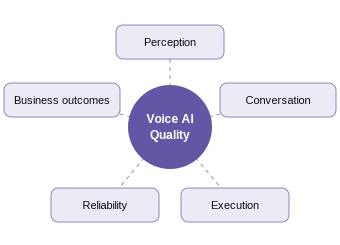
A weakness in any one dimension can undermine the rest. Excellent speech recognition can't compensate for an incorrect pricing policy. A sophisticated reasoning model can't compensate for an unreliable scheduling integration. And a perfectly executed transaction can still leave a caller frustrated if the conversation feels robotic.
Three stakeholder perspectives on quality
Different teams judge the same agent through different lenses, and a production-ready agent has to satisfy all of them.
Engineering sees a distributed, real-time system where errors compound across components. The questions are end-to-end response latency; recognition accuracy on names, numbers, addresses, accents and domain terms; handling of interruptions, backchannels, pauses and mid-sentence corrections; tool execution reliability; and whether performance holds during peak volume and provider failures.
Business owners care less about model benchmarks and more about outcomes. Did the caller's issue get resolved? Was the sales opportunity captured? What did the successful interaction cost? Can the business handle more calls without adding headcount at the same rate? Traditional IVRs optimized for containment, keeping callers away from human agents. Modern voice AI should optimize for resolution. Deflecting a caller without solving their problem just creates repeat calls, cost and frustration.
Customers, operations and compliance each want something different. Customers want effortlessness: the agent understands them, accepts corrections, doesn't make them repeat themselves and transfers them when automation reaches its limits. Operations and CX teams want control: they need to see why calls fail and change policies without rebuilding the system. Legal, security and compliance teams want predictability and auditability: identity verification, data-access limits, documented decisions and enforceable guardrails.
How to evaluate voice AI agents: metrics and benchmarks
The best way to evaluate a voice AI agent is to combine component-level metrics with end-to-end measurements of business outcomes. Testing individual speech and language models is necessary but not sufficient: the whole system must complete the intended task correctly under realistic conditions.
Essential voice AI evaluation metrics
These are illustrative engineering and operational targets, not universal industry benchmarks. The right thresholds depend on workflow complexity, customer expectations, risk and deployment conditions.
What is a good response latency for a voice AI agent?
Research on human conversation shows that speakers typically hand off turns within a few hundred milliseconds, which sets a high bar for AI phone conversations. For routine turns, sub-second end-to-end latency is a useful starting objective, and highly optimized systems can go much lower. (We break down a 500 ms budget stage by stage in Sub-500ms Voice Agents: Optimizing the Full STT-LLM-TTS Pipeline.)
A single latency number rarely tells the whole story. Measure:
- P50 latency: the typical caller experience.
- P95 latency: the slow turns callers regularly hit.
- P99 latency: extreme delays, often caused by infrastructure or provider issues.
- Time to first meaningful response: how quickly the agent says something useful, not just a filler phrase.
- Barge-in latency: how quickly the agent stops talking when the caller interrupts.
Separate model inference latency from what the caller experiences. A TTS model that produces first audio in 100 ms does not make a voice agent that responds in 100 ms: telephony, endpointing, reasoning, tool calls, buffering and playback all add to the total. The goal is not just to generate audio faster. It is to minimize the delay before a useful, contextually appropriate response.
Why word error rate is not enough
Word error rate is the standard metric for speech recognition:
But not every transcription error has the same consequence. Take a leasing agent that hears: "I'd like to schedule a tour for apartment 304 on Thursday." If the recognizer drops "I'd like to," the outcome is unchanged. If it hears apartment 340 instead of 304, the agent books the wrong tour. Both errors count toward WER, but only one breaks the business task.
Production systems should measure critical entity accuracy alongside aggregate WER, and confirm high-impact details with the caller before taking irreversible actions.
Task success rate: the most important voice AI metric
Task success rate measures whether the agent completed what the caller actually wanted. For transactional workflows, success should be verified against the business system itself, not inferred from the transcript. Consider this call:
A transcript-based evaluation might score this call as a success. A backend-aware evaluation catches both the execution failure and the false confirmation. That distinction is the foundation of production voice AI quality assurance.
Voice AI architecture: cascaded vs. speech-to-speech vs. full-duplex
A production voice agent coordinates six layers: telephony and media transport; audio processing and speech perception; conversation orchestration and state; language understanding and reasoning; speech generation; and external tools and business systems. How these layers interact determines the system's ceiling for speed, intelligence, reliability and naturalness.
There are two main modeling approaches, cascaded pipelines and native audio models. Whether a system takes explicit turns or runs full-duplex is a separate architectural dimension.
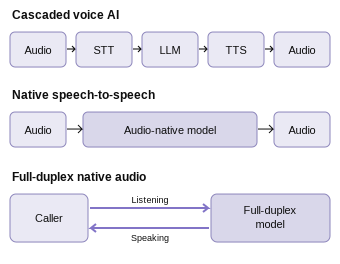
These categories overlap. A cascaded system can listen and speak at the same time, and a native speech-to-speech model may still use explicit turns.
Cascaded voice AI architecture
A cascaded architecture splits the work across speech-to-text (STT), a large language model (LLM) that reasons over business context and calls tools, and text-to-speech (TTS). Its main advantage is control: each model can be selected, evaluated, hosted or fine-tuned for its role, which gives engineering teams room to optimize latency, accuracy and cost. That makes cascaded systems attractive wherever deterministic business rules, API integrations and traceability matter. The main challenge is coordinating several real-time components without adding latency or losing useful information from the original audio. Contrary to a common claim, cascaded agents are not inherently stuck at one second or more: streaming, speculative inference, semantic endpointing and colocated infrastructure can bring them well below that.
Native speech-to-speech architecture
Native speech-to-speech models work on audio more directly, so they can keep information that transcription throws away: intonation and emphasis, hesitation, emotional context and speaking patterns. Commercial examples include the OpenAI Realtime API, Google Gemini Live and Amazon Nova Sonic. The trade-off is usually less component-level modularity and more dependence on one model provider. In enterprise deployments, native audio models still need reliable tool execution, access controls, business policies and production observability.
Full-duplex voice AI
Full-duplex voice AI processes incoming audio while it generates outgoing audio, instead of strictly alternating between listening and speaking. That enables natural backchanneling ("mm-hmm"), mid-sentence corrections, more nuanced interruption handling and well-timed pauses. Research such as Kyutai's Moshi shows how native full-duplex models can support these behaviors. But full-duplex does not automatically make an agent faster, and it doesn't solve business reasoning, tool execution or operational reliability. The architecture that produces the most natural conversation is not necessarily the one that produces the most reliable business agent.
Voice AI engineering best practices
Whatever the architecture, a handful of engineering practices separate production-ready voice agents from prototypes.
Optimize the whole latency pipeline
Cutting latency means optimizing the critical path across the system, not just picking the fastest individual models. Common techniques:
- Stream speech recognition before the caller finishes speaking.
- Use semantic endpointing to cut unnecessary silence.
- Speculatively prepare likely responses.
- Stream LLM output directly into speech synthesis.
- Colocate inference and orchestration.
- Remove unnecessary network round trips.
- Run independent backend calls concurrently.
Some of these have costs. Speculative generation can raise inference spend and produce responses that get thrown away. Aggressive endpointing can make the agent cut callers off. Always evaluate latency alongside task accuracy and conversation quality.
Use semantic turn detection, not silence timers alone
Voice activity detection finds speech and silence. It doesn't know whether the caller has finished a thought. In "I'd like to schedule a tour for... actually, let me check my calendar... next Thursday," a fixed silence threshold treats the first hesitation as the end of the turn. Semantic turn detection uses linguistic context, and sometimes acoustic cues, to judge whether the speaker is done. Production systems need to tell three events apart:
Handle slow tool calls asynchronously
Voice agents talk to CRMs, scheduling platforms, payment systems and internal databases, many of which respond far more slowly than the voice models. Instead of leaving the caller in silence, a production agent should acknowledge that it's working, run independent operations in parallel, apply explicit timeouts and recovery rules, give progress updates during long operations and never confirm success before it has a verified result. For complex workflows, a fast conversational agent can hand deeper reasoning to asynchronous backend agents while it keeps the live conversation going.
Design for multi-provider resilience
Every model provider has outages, rate limits and slow days. Plan for STT, LLM and TTS failures, SIP and telephony drops, external API outages and sudden spikes in concurrent calls. Fallbacks must preserve conversation state and avoid duplicate business operations: retrying an interrupted booking must not create two reservations.
Choose the right audio transport
WebRTC is the usual choice for browser and mobile audio because it handles jitter and network congestion. WebSockets are common for server-to-server streaming, and SIP connects agents to existing business phone systems. The right choice depends on your deployment environment, network conditions, model providers and telephony requirements.
Test audio preprocessing under real conditions
Noise suppression, echo cancellation and voice isolation can improve recognition and interruption handling, but too much filtering distorts speech and removes useful signal. Test against car and street noise, speakerphone echo, competing voices, poor mobile connections, narrowband phone audio and a range of volumes and accents. The best configuration is the one that improves downstream task completion, not the one that produces the cleanest-sounding recording.
Build vs. buy: choosing a voice AI implementation strategy
Choosing how to build a voice agent is really a decision about who owns the infrastructure, the business workflow and the work of improving it after launch.
Build in-house when voice AI is core intellectual property, you need specialized orchestration or model architectures, you need direct control over infrastructure and data residency, and you have the engineers and the call volume to justify running real-time systems. The initial agent is only a fraction of that long-term commitment.
Use an open-source framework when you're engineering-led and don't want to build media transport and orchestration from scratch. LiveKit Agents fits teams building around WebRTC and SIP; Pipecat gives fine-grained control over frame-based pipelines. Either way, you still own deployment, testing, scaling and optimization.
Use a managed platform when you have people who can configure and maintain workflows but don't want to run voice infrastructure. A managed infrastructure platform is not the same as a managed business agent, though: someone still owns workflow design, integrations, prompt and policy updates, evaluation, failure investigation and ongoing improvement.
Use a voice AI control plane when you want to launch quickly but keep the option to go deeper later: hosting your own models, retraining them on your calls and centralizing operations across agents and providers. We compare these options in detail, including a 12-month cost model, in Voice AI Control Plane vs. DIY Orchestration.
The hidden cost of voice AI: the handoff tax
When an operations manager spots a failed call, what happens next? With an in-house system, it becomes an engineering ticket. With an outsourced build, it crosses company boundaries. With a self-service platform, the ops team investigates and edits the workflow themselves. When the STT vendor, the LLM provider, the TTS vendor and the orchestration layer are four different companies, nobody owns the whole failure. Every handoff adds delay, coordination cost and lost information. How quickly you can find a failure and ship a validated fix is one of the most overlooked costs of owning a voice agent.
How to calculate the true cost of voice AI
Per-minute pricing is only part of voice AI economics. A more useful number is:
Total operating cost includes telephony, inference and hosting, platform fees, engineering and maintenance, QA and monitoring, and the human escalation and rework that failed calls create. Compare two hypothetical agents handling 10,000 calls a month:
Agent B costs more per call but less per resolution, and that's before counting the staff time needed to handle Agent A's 4,500 unresolved calls. Cheap inference is valuable. Cheap, successful resolution is more valuable. For a full breakdown of infrastructure costs at volume, see How to Scale Voice AI Agents to 1,000+ Concurrent Calls.
How to test voice AI agents before production
Voice AI testing has to cover what the agent says, what it does, when it does it and how it recovers when something goes wrong. A complete strategy has four layers.
1. Component testing. Evaluate STT, LLM, TTS and tool integrations independently, so you know which component is responsible for a bottleneck.
2. End-to-end conversation simulation. Simulate complete calls across your real intents and workflows, including ambiguous requests, corrections, multiple requests in one call, interruptions and long pauses, background noise and poor audio, unexpected API responses and requests outside the agent's authority. Run important scenarios many times: you're measuring consistency, not whether the agent can succeed once.
3. Business outcome verification. Confirm that the agent's actions left the right state in your systems. For a leasing agent, the correct appointment exists on the correct property's calendar. For support, the return was submitted and the confirmation sent. For sales, the lead was qualified and routed to the right team.
4. Production monitoring and regression testing. After launch, production calls become your best source of new test cases. Every significant failure should lead to a root-cause investigation, a reproducible test case, a targeted fix, regression testing against workflows that already work, and a controlled rollout with monitoring. That loop connects real customer calls directly to agent development.
For a hands-on example of wiring tools, observability and testing into a working agent, see Building a Production-Ready Inbound Voice Agent in Under 10 Minutes.
Production voice AI readiness checklist
Before a voice agent talks to real customers, check it against each of these areas.
Conversation quality
- Response latency is measured at P50, P95 and P99.
- Interruptions, corrections and backchannels are handled correctly.
- Speech recognition is tested on representative phone audio.
- Responses are concise and written for the ear, not the screen.
Business workflow reliability
- Critical caller information is confirmed.
- Tool executions are validated.
- Failed operations can't produce false confirmations.
- Retries can't create duplicate transactions.
- Task completion is independently measurable.
Safety and compliance
- Identity verification requirements are enforced.
- Access to sensitive data is restricted.
- High-risk actions require appropriate authorization.
- Escalation triggers and human handoffs are defined.
- Recording, retention and AI-disclosure policies are in place where they apply.
Infrastructure and operations
- Peak concurrency is load-tested.
- Provider outages and API timeouts are simulated.
- Agent versions and configuration changes are tracked.
- Production failures raise actionable alerts.
- Changes can be rolled back safely.
Continuous improvement
- Production calls can be reviewed systematically.
- Failed calls can be turned into regression tests.
- Operations teams can investigate and prioritize issues.
- Improvements are validated before deployment.
- Business outcomes are tracked over time.
How Bearworks approaches voice agent quality
Most of the failures in this guide don't happen inside a single model. They happen at the seams: between the recognizer and the reasoning layer, between the agent and the booking API, between the team that spots a bad call and the team that can fix it. Bearworks is built to close those seams. Our voice AI control plane brings speech-to-text, text-to-speech, AI agent orchestration, model hosting and model retraining into one platform, so you can see every call and improve the models behind it.
Here is how that maps to the five dimensions of quality:
Why teams choose Bearworks
- One platform, no handoff tax. When a call goes wrong, you trace it across speech recognition, reasoning, voice and tools in one place, with one team accountable, instead of filing tickets with four vendors.
- Agents that improve, not just run. Model hosting and retraining close the improvement loop. Production calls become training and test data, and fixes ship as validated releases rather than prompt tweaks made in a hurry.
- Test before your callers do. Simulate conversations before launch, including unclear requests, callers asking for a person and urgent escalations, then refine the instructions until every scenario reaches the right next step.
- Every call is reviewable. Call outcomes, short summaries and full transcripts for every conversation give operations and compliance teams the visibility they need without waiting on engineering.
- Sounds like your business. Choose from a voice library, or clone the voice of one of your own representatives with their written permission. Agents can speak with callers in their preferred language and answer 24/7.
- Your team stays in charge. Agents handle intake, check calls, follow-ups and callbacks, then hand off with context, so your people make the decisions that need judgment: pricing, approvals, coverage, exceptions.
- Start small and prove it. Start with one call type, inbound or outbound, on a connected number. The free plan includes 15 call minutes a month with no card required, so you can measure task success on real calls before you commit.
The continuous improvement loop
A mature voice AI deployment runs a repeatable cycle: observe, diagnose, evaluate, improve, validate, deploy, and back to observe.
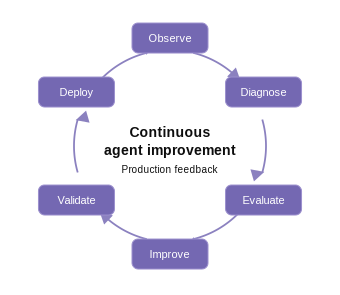
On Bearworks, each step has a home. Transcripts and call outcomes show you what happened. Reviewing failed calls tells you why. Simulated conversations turn each failure into a repeatable test. Retraining and instruction changes fix it. The same simulations validate the fix before it reaches callers. The value compounds: an agent handling thousands of calls produces a steady stream of information about caller behavior, workflow bottlenecks and model weaknesses. Teams that systematically turn that into better performance pull ahead of teams that treat voice AI as a one-time project.
Where voice AI quality is heading
The next generation of voice agents won't be defined only by better voices or bigger foundation models. It will be defined by how well systems learn from operational experience. Five trends are driving that shift:
- Full-duplex and audio-native models that better understand timing, vocal signals, interruptions and overlapping speech.
- Specialized, domain-trained models that improve accuracy for specific tasks and industries while cutting latency and inference cost.
- Context-aware speech recognition that uses business and conversation context to recognize expected entities and specialist vocabulary.
- Asynchronous agent delegation, where a responsive conversational agent hands complex work to backend agents without going quiet.
- Automated quality assurance that finds recurring failures, links them to technical causes and turns production calls into concrete improvements.
Voice AI quality is an operational discipline
The difference between an impressive voice AI demo and a reliable production system isn't just the models. It's the engineering, operational controls, business integrations and improvement process around them. When you evaluate a voice AI solution, look past voice naturalness, per-minute pricing and headline latency. Ask whether the agent reliably completes the tasks your customers care about. Ask how failures are detected and fixed. And ask who is responsible for making sure the agent performs better next month than it does today. If you're comparing vendors, 5 Questions to Ask Any Voice AI Agent Vendor turns those questions into a buyer's checklist.
You shouldn't have to choose between conversational quality, operational reliability and cost efficiency.
Frequently asked questions
How do you measure the quality of a voice AI agent?
Measure voice AI agent quality across five dimensions: perception (speech and entity accuracy), conversation (latency and interruption handling), execution (task success and tool-call accuracy), reliability and safety, and business outcomes such as first-call resolution and cost per resolution. The most effective evaluations check both what the agent said and whether the intended action actually completed in the underlying business system.
What is a good latency for a voice AI agent?
Sub-second end-to-end response latency is a useful starting target for routine conversational turns, and highly optimized systems can go substantially lower. Measure P50, P95 and P99 latency, separate filler acknowledgments from meaningful responses, and account for slow backend operations.
What is the difference between cascaded and speech-to-speech voice AI?
Cascaded voice AI uses separate speech-to-text, language model and text-to-speech components. Speech-to-speech AI processes and generates audio more directly through an audio-native model. Cascaded systems generally offer more component-level control and easier debugging, while native audio systems can preserve richer conversational signals such as tone and hesitation.
What is full-duplex voice AI?
Full-duplex voice AI processes incoming speech while it generates outgoing speech, instead of strictly alternating between listening and speaking. This enables more natural interruptions, backchanneling and real-time reactions. It is a separate dimension from cascaded versus speech-to-speech, and it does not by itself make an agent faster or more reliable at business tasks.
What is the most important metric for voice AI performance?
For most transactional business applications, task success rate is the most important metric because it measures whether the agent actually completed the caller's objective. Verify it against the business system rather than the transcript, and track it alongside customer experience, safety and cost per successful resolution.
How do you test a voice AI agent?
Test voice AI agents in four layers: component testing of speech, language and tool integrations; end-to-end conversation simulation; verification that the right state was created in business systems; and ongoing production monitoring with regression tests. Cover realistic audio, interruptions, ambiguous requests, failed API calls and repeated runs of important workflows.
How much does it cost to operate a voice AI agent?
Operating cost depends on telephony, model inference, hosting, platform fees, engineering, quality assurance and human escalation. Cost per successful resolution, meaning total operating cost divided by successfully resolved calls, gives a more complete picture than per-minute pricing alone.
Should an enterprise build or buy a voice AI agent?
Build in-house when voice AI is core intellectual property and you can staff real-time infrastructure. Managed platforms suit teams that want infrastructure handled but are prepared to own workflows. A voice AI control plane suits teams that want to launch quickly while keeping the option to host, retrain and centrally operate their own models as they scale.
What is a voice AI control plane?
A voice AI control plane is the operational layer that configures, coordinates, monitors, evaluates and improves voice AI systems. It connects speech models, agents, telephony, business tools and operational controls so teams can manage agents reliably through their production lifecycle.
How does Bearworks help improve voice agent quality?
Bearworks brings speech-to-text, text-to-speech, AI agent orchestration, model hosting and model retraining into one voice AI control plane. Teams can simulate conversations before launch, review call outcomes, summaries and transcripts for every call, and retrain models on their own domain vocabulary, so failures are found and fixed in one place rather than across several vendors.
Assumptions behind these numbers
- Metric targets: the thresholds in the evaluation metrics table are illustrative engineering and operational starting points, not universal industry benchmarks or measured Bearworks results.
- Cost example: Agent A and Agent B are hypothetical. Per-call costs and resolution rates were chosen to illustrate cost per resolution, not taken from any vendor's pricing.
- Model and framework capabilities: speech-to-speech models, LiveKit, Pipecat and managed platforms change quickly. Check each provider's current documentation before you commit to an architecture.
Sources and further reading
- ServiceNow AI: A new framework for evaluating voice agents (EVA)
- OpenAI Cookbook: Voice agent evaluation
- Universals and cultural variation in turn-taking in conversation (PNAS)
- Moshi: A speech-text foundation model for real-time dialogue
- LiveKit: Turn detection and interruption handling
- Pipecat
- Sub-500ms Voice Agents: Optimizing the Full STT-LLM-TTS Pipeline
- Voice AI Control Plane vs. DIY Orchestration: When to Build, Buy, or Self-Host
- 5 Questions to Ask Any Voice AI Agent Vendor Before You Buy
Turn Calls into Deals
with Bearworks
Ready to get started? Book a demo: